
Need surgery or a medical procedure? How to know what you'll pay
Need surgery or a medical procedure? How to know what you'll pay
When you’re planning a medical procedure, figuring out how much money you'll owe isn’t always easy. In fact, for a lot of us, it can feel downright confusing. It doesn’t have to be.
Often, when you arrive at a hospital, a finance clerk will give you an upfront price, sometimes offering a discount before you’ve even had a chance to change into a hospital gown. That price is usually not what you would owe, and you can wait to pay until you understand your full costs. There’s no ill intent—they’re simply giving you an estimate, but it doesn’t always take your insurance benefits into account.
Understanding a few key things about how your health plan works will make it much easier for you to avoid sticker shock and give you confidence to know your costs before you go.
How your health plan works
What you pay depends on where you are in your plan year. Here are some terms to know and how the math works: 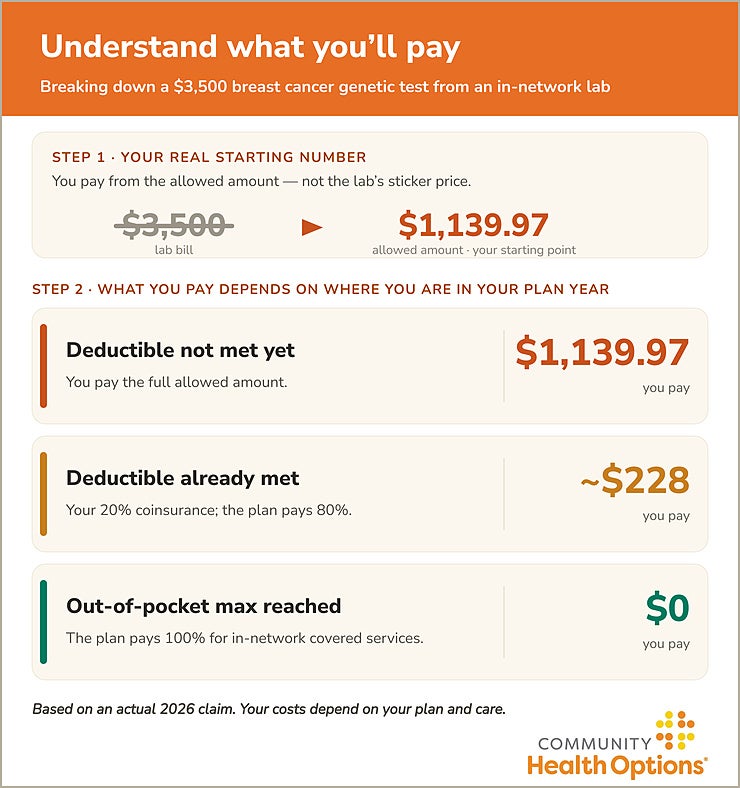
- Allowed amount—the price your insurer negotiates: Let's imagine an in-network lab sends Community Health Options a $3,500 claim for genetic testing, which will help guide a Member's breast cancer treatment. The negotiated "allowed amount" totals $1,139.97. Once we process the claim, the Member receives an Explanation of Benefits (EOB) showing both amounts and what she might expect to pay.
- Deductible—how much you would pay before your health plan pays anything: When she got the test, the Member hadn't yet reached her deductible, and thanks to the EOB, it came as no surprise when she received her final bill.
- Coinsurance—your share of a medical bill that you split with your health plan: Once the Member met her deductible, her plan next covered 80% of her costs. In that case, she’d owe 20%, or about $228. Some services also have a flat fee, or copay, instead, like paying $50 for a specialist’s office visit.
- Out-of-pocket maximum—the most you’ll pay for claims: Once you pay a certain total amount, your insurance takes over. That means you won’t pay anything for covered services as long as you stay in-network. Note that costs for out-of-network services could apply. Premiums also do not count toward your maximum.
Here’s a pro-tip: You can generally see your deductible right in your plan name. For example, if you have a Health Options Clear Choice Silver $4000 PPO National Plan, your in-network deductible will be $4,000. You may also have a separate deductible for out-of-network services. Check your plan docs for details.
Skip the surprise bills
Even if you know all the insurance terms, there are lots of ways to know how much you might pay before you go for care. Here’s how to get help:
- Ask for an estimate: Your provider can give you a good faith estimate of costs for your procedure, including extra services that could be part of your care, like anesthesia, lab work or imaging.
- Get your procedure's CPT code: Your doctor sends a CPT code to your insurer for Prior Authorization to ensure your plan covers the service. If you live in Maine, that code unlocks information for you, too. You can use it to do your own research, like going to CompareMaine.org to see how much services cost at different facilities. You can also use the Cost Estimator tool in your Member Portal.
- Stay in-network and shop around: Costs vary among healthcare settings, sometimes even when facilities are right next to each other. Staying in-network gets you the negotiated price—and you can always ask your doctor to refer you to in-network providers. If you want to go out-of-network, check your plan for your level of coverage.
- Use your benefits: As an example, Community Health Options health plans offer lower rates at specified sites of service. A similar program is available for infusions. If you are a Member, you can find details in your Member Portal or contact Member Services for help.
Get support
Community Health Options’ Maine-based Member Services team is here to help. The team can help you:
- Understand claims and estimate costs
- Find potential lower-cost options for care
- Understand your deductible
- Confirm you have Prior Authorization and that your upcoming care is covered
- Explain a Prior Authorization denial and help you appeal, if necessary
- Find an in-network provider
- Get the most out of your benefits
- Connect with a Care Manager for support managing complex care, like upcoming cancer treatment
Note: This guide is for planned care. If you have an emergency, don't wait or shop around. Get care right away. The federal No Surprises Act protects you from surprise bills for emergency care, even if it's out-of-network.
Specific plan benefits vary, so please check your plan’s schedule of benefits for details. Have a question about Community Health Options or your benefits? Call our Maine-based Member Services team at (855) 624-6463, between 8 a.m. and 5 p.m., Monday through Friday.
Follow Community Health Options on Facebook, LinkedIn, TikTok or Instagram
Related Blog Posts

Five things to consider when looking for health insurance
Buying health insurance probably isn’t among the more exciting purchases you’ll ever make. But like it or not, it’s one of the most important. So, we want to help you get it right.

Comparing health plan prices? Estimate your yearly spending, too
It might be tempting to buy a health plan based on the lowest monthly premium, but if you do, you might be surprised by your out-of-pocket costs at the end of the year. When you compare plan prices, it’s important to estimate your upcoming yearly costs so you can find a plan that meets your needs.

Coming soon: A simpler online tool to help Members manage their benefits
Community Health Options Members are about to get access to a new portal and mobile app so it's easier to find health plan information and understand their out-of-pocket costs.